
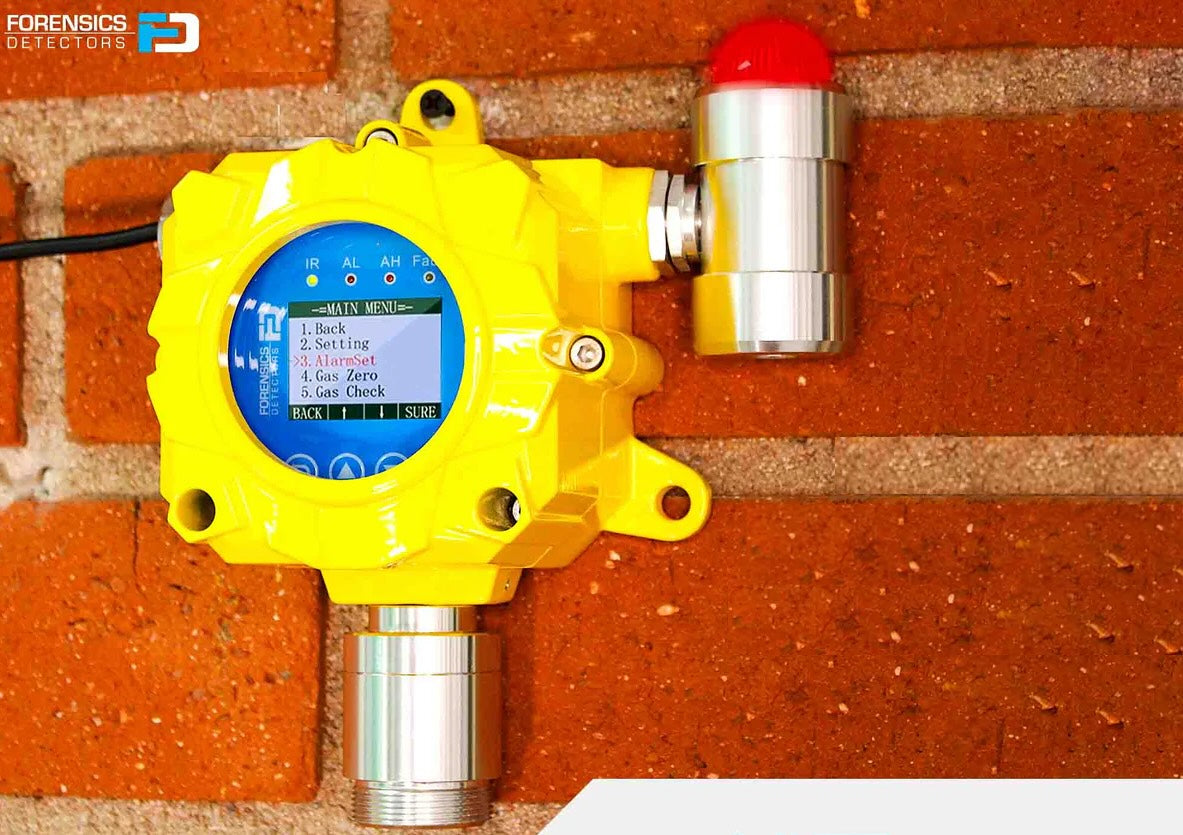
We receive many calls and emails from Distilleries, breweries, and Wineries inquiring about alcohol, explosive, O2, and CO2 monitors and detectors. The prime objective is to ensure workplace safety in alcohol production. Dangers exist when dealing with the high-proof vapors of a distillery, the fermentation gases of a brewery, or the storage conditions of a winery. Alcohol vapor and process gases like methane or carbon dioxide pose both inhalation and explosive risks. So given these many questions over the years, I have put this guide to provide essential answers to the most common questions regarding gas detection systems for Distilleries, breweries, and Wineries.
What is the difference between fixed and portable monitors?
Fixed monitors protect specific areas 24/7. Portable (personal) monitors clip to clothing to provide immediate, localized protection for individuals entering confined spaces or tanks.
Why do distilleries need explosive gas detectors?
Yes they do.
The primary hazards include ethanol vapor, which is highly flammable and heavier than air; methane, often used in boilers and heating systems; carbon dioxide (CO₂), a byproduct of fermentation that can displace oxygen; and oxygen depletion, which occurs when gases like CO₂ or nitrogen accumulate in confined spaces. Installing a combination of EX LEL wall-mount units and O₂ depletion monitors is essential for early warning and preventing catastrophic accidents in production areas. Here is a video of a brewery installing an EX LEL detector to switch on an exhaust fan triggered by accumulated alcohol vapor.
Why is CO2 dangerous in a brewery?
CO2 is an odorless, colorless asphyxiant. It displaces oxygen in the air; high concentrations can cause dizziness, unconsciousness, or death by suffocation within seconds.
Why is O2 monitoring necessary?
O2 monitors detect oxygen deficiency (suffocation risk) or oxygen enrichment (fire and explosion hazard). Both extremes are life-threatening in industrial settings.
What are the legal limits for CO2 exposure?
OSHA sets the Permissible Exposure Limit (PEL) at 5,000 ppm (0.5%) over an 8-hour Time Weighted Average (TWA). Short-term exposure limits (STEL) are typically 30,000 ppm.
Can ethanol vapor in barrel rooms actually reach explosive concentrations?
Yes. While barrel aging warehouses (rickhouses) are generally ventilated, ethanol vapor is heavier than air and can accumulate in low-lying areas, floor pits, or dead zones if airflow is stagnant.
Is CO₂ a bigger risk than ethanol vapor in wineries?
In wineries and breweries, CO₂ is often the more immediate safety threat. During active fermentation, yeast converts sugars into alcohol and massive volumes of CO₂.
Do I need a fixed gas detection system or is a portable monitor sufficient for a craft distillery?
You need both.
Fixed systems provide 24/7 protection, monitoring for leaks even when the facility is empty, and can trigger automatic exhaust fans.
Portable EX LEL units are essential for "spot checking" areas during maintenance, moving between different rooms, or ensuring safety before entering a potentially hazardous space. Relying solely on a portable monitor leaves you vulnerable during off-hours, while relying only on a fixed system prevents staff from checking their immediate environment for mobile leaks.
What's the best gas detector for a barrel aging warehouse (rickhouse) versus a still room?
For a still room, use fixed, explosion-proof (EX) LEL detectors mounted near potential leak sources (pumps, valves, still heads). Because these areas involve high-proof vapors, rapid response is vital. For a barrel aging warehouse, focus on low-level continuous monitoring. Since ethanol vapor is heavy, place sensors near the floor in areas where air circulation is poor.
What do OSHA and NFPA (particularly NFPA 30 and NFPA 497) require for gas detection in distilled spirits facilities?
NFPA 30 (Flammable and Combustible Liquids Code) and NFPA 497 (Classification of Flammable Liquids, Gases, or Vapors) dictate that if a hazardous atmosphere can exist, you must have controls in place. OSHA 1910.106 specifically governs the storage and handling of flammable liquids. These codes require that facilities identify "Hazardous Locations" and use equipment rated for those zones. While they don't explicitly mandate a specific number of detectors, they mandate that you mitigate explosion risks; therefore, continuous monitoring is the industry-standard method to satisfy these safety requirements.
Are gas detectors required for confined space entry into fermentation tanks or wine vats (OSHA 29 CFR 1910.146)?
Yes, absolutely.
OSHA 1910.146 mandates that before anyone enters a permit-required confined space, the atmosphere must be tested. You must verify: 1) Oxygen levels are between 19.5% and 23.5%; 2) Flammable gases (LEL) are below 10%; and 3) Toxic gases (like CO or H₂S) are within safe limits. A portable 4-gas monitor, like our FD-4A, or for pre-entry, using FD-600-4GAS - are standard tools. You should also maintain continuous monitoring while the person is inside the tank to account for potential leaks or displacement occurring during work.
What alarm setpoints should I use — 10% LEL, 20% LEL, or something else?
Industry best practice is a two-stage alarm system.
-
Low Alarm (10% LEL): Triggers a "caution" state. This activates local ventilation and alerts staff to investigate the source of the leak.
-
High Alarm (20% LEL): Triggers an emergency state. This should automatically shut down processing equipment, activate high-volume exhaust, and force an immediate site evacuation.
Do not wait for higher levels, as vapor clouds can reach explosive limits in pockets very quickly.
Where should fixed gas detectors be mounted — near the floor, ceiling, or breathing zone?
Placement depends on the gas being monitored:
-
Ethanol Vapor: Heavier than air. Mount sensors 6–18 inches off the floor near potential leak sources.
-
CO₂ (Fermentation): Heavier than air. Mount sensors 6–18 inches off the floor in low-lying areas or pits.
-
Methane (Boiler Fuel): Lighter than air. Mount sensors 12 inches from the ceiling.
-
Oxygen: Mount at "breathing zone" height (4–5 feet) for personnel protection.
How does high humidity in a barrel room or cellar affect sensor accuracy and lifespan?
High humidity can cause "sensor drift" and premature failure. Moisture can condense on the sensor element, physically blocking gas from reaching the sensing material, or cause corrosion on internal circuitry.
In barrel rooms, use sensors with hydrophobic filters or environmental enclosures rated for high humidity (IP65 or higher). Additionally, sensors in humid environments require more frequent calibration checks—typically every 3 to 6 months—to ensure that moisture hasn't compromised the detection accuracy.
What should my team do when the low or high alarm goes off?
You need a written Emergency Action Plan (EAP).
-
Low Alarm (10% LEL): Stop work. Increase ventilation if possible. Identify the source of the leak. Notify the safety officer. Do not resume work until readings return to zero.
-
High Alarm (20% LEL): Stop all machinery, evacuate the building immediately, and do not re-enter until emergency responders declare the area safe.
How do local fire codes differ from national standards regarding alcohol vapor monitoring?
National standards like NFPA provide the baseline, but local fire marshals have the authority to impose stricter requirements. In some jurisdictions, the local fire code may explicitly require continuous monitoring tied to an automated fire alarm system regardless of facility size.
Does my insurance policy have specific requirements for automated gas detection systems?
Yes, many do. To manage the high risk of fire in distilleries, insurers often require that gas detection systems be "fail-safe."
What does "LEL" stand for, and why is it the standard unit of measurement for these detectors?
LEL stands for Lower Explosive Limit. It is the lowest concentration (percentage of volume) of a gas in air capable of producing a flash of fire in the presence of an ignition source. It is the industry standard because it allows for a universal safety scale: 0% LEL means no gas, while 100% LEL means the atmosphere is at the precise point of explosion. This makes it easy for operators to understand risk levels without needing to memorize complex chemical concentration percentages for different gases.
Since alcohol vapor is heavier than air, does that change where I should mount my sensors?
Yes, significantly. Because ethanol vapor (vapor density 1.59) is heavier than air, it will naturally sink and pool in low spots, floor drains, and pits. Mounting sensors on the ceiling is ineffective and dangerous for alcohol monitoring. Sensors must be mounted 6 to 18 inches above the floor level in areas where air does not circulate well. Conversely, if you are also monitoring for natural gas (methane) in the same room, you must mount those sensors near the ceiling, as methane rises.
Should sensors be placed near process equipment or near the facility exits?
Both. Sensors near process equipment (stills, bottling lines) provide the fastest response to leaks, allowing you to stop the problem at the source. Sensors near facility exits or along escape routes provide a "perimeter" check, ensuring that an invisible vapor cloud doesn't block your team’s path to safety. Prioritize the equipment areas first, as that is where the danger originates. Perimeter monitoring is a secondary layer of protection for facility-wide safety.
Are there "dead zones" in a barrel room that a sensor might miss?
Yes. Any area with restricted airflow is a dead zone. This includes under staircases, behind large racks, in storage pits, or corners with no ventilation. Ethanol vapors love these spots. When installing fixed systems, do a smoke test (using a non-toxic smoke generator) to map the airflow in the room. If the smoke lingers in a corner, put a sensor there. Don’t assume the room is safe just because you have one sensor in the middle of the warehouse.
Can the detection system automatically trigger exhaust fans when a threshold is reached?
Yes, this is one of the most important features of a fixed gas detection system. Using built-in relay outputs, the detector can communicate directly with your building’s HVAC or exhaust system. When the alarm threshold (e.g., 10% LEL) is crossed, the relay closes, triggering the fans automatically. This "interlock" provides an immediate, automated response that doesn't rely on human intervention, potentially preventing a minor leak from ever escalating into an explosive event.
What is a safe oxygen level?
Normal atmospheric air is 20.9% oxygen. OSHA considers 19.5% to 23.5% as the "safe" range for breathing. Levels below 19.5% are oxygen-deficient; above 23.5% are oxygen-enriched.
Where does CO2 tend to accumulate?
CO2 is heavier than air. It settles in low-lying areas, floor drains, pits, cold rooms, fermentation cellars, and confined spaces.
What is "Oxygen Enrichment" and why does it happen?
This occurs when pure oxygen leaks, making materials highly flammable. Even common items like clothing can ignite spontaneously in enriched environments.
Does Nitrogen (N2) pose similar risks?
Yes. Nitrogen is an inert gas used for carbonation and purging. Like CO2, it is an asphyxiant and displaces oxygen, making O2 monitoring essential in areas where N2 is stored or used.
Where should I install fixed CO2 monitors?
Install sensors in low-lying areas where CO2 pools, typically 12–18 inches off the floor in potential accumulation zones like fermentation cellars and walk-in coolers.
Where should I install fixed O2 monitors?
Install O2 sensors at "breathing zone" height, approximately 4–6 feet off the ground, where workers typically inhale air.
Do I need visual and audible alarms?
Yes. OSHA requires alarms to be both audible and visual so workers are alerted even in loud brewery environments or if they are wearing hearing protection.
What is a "Confined Space" in a brewery?
Any area with limited egress not designed for continuous occupancy, such as bright tanks, fermenters, or deep pits. These require permit-based entry and pre-entry atmospheric testing.
Who needs to wear a personal monitor?
Any employee working in areas with gas storage, confined space entry, or where leaks are possible should wear a personal multi-gas monitor.
How often should monitors be calibrated?
Follow manufacturer guidelines, typically every 12 months. Sensors can "drift" over time, rendering them inaccurate if not periodically zeroed and spanned with calibration gas.
How long do gas sensors last?
Most sensors (electro-chemical and catalytic) last between 2 and 3 years.
Do I need to document safety checks?
Yes. OSHA requires documented proof of calibration, bump testing, and employee training. Keep a logbook or digital record for all safety equipment maintenance.
Conclusion
Combining fixed EX LEL wall-mount units for facility protection, portable EX LEL monitors for individual safety, and specialized O₂ and CO₂ sensors for process environments is the way to go in order to create multiple layers of defense against the invisible risks of alcohol production. Investing in high-quality hardware and maintaining a strict calibration schedule protects your staff, your facility, and your bottom line from the devastating impact of preventable accidents.