

A photoionization detector (PID) is a VOC PID Analyzer that measures volatile organic compounds (VOCs) in air. Instead of relying on a chemical reaction inside an electrochemical sensor, a PID exposes sampled gas to ultraviolet energy and measures the electrical signal created when detectable molecules are ionized. This gives PID technology fast response, broad VOC sensitivity, and the ability to measure concentrations ranging from very low ppm levels to much higher industrial concentrations.
Pros |
Cons |
|
✅ Very fast response to a broad range of VOCs. ✅ Can detect down to 0.01ppm. ✅ PID is superior to electrochemical sensors but more expensive. |
⛔ A PID cannot automatically identify an unknown VOC. ⛔ Detects most VOCs but not all. ⛔ Requires annual calibration. |
What is the Best Photoionization Detector (PID) for VOCs?
- Forensics Detectors | PID VOC | 0.01 ppm | Low-Range
-
Forensics Detectors | PID VOC | 0-1000 ppm | High-Range
- Ion Science TIGER XT VOC PID
-
Honeywell PID VOC UltraRAE 3000
- RKI PID VOC 6000
What Is a Photoionization Detector Used For?
A photoionization detector is used for rapid measurement and screening of VOCs in workplaces, industrial facilities, contaminated environments, chemical storage areas, manufacturing processes, spill investigations, environmental assessments, and other locations where organic vapors may be present.

How Does a 10.6 eV PID Sensor Detect VOCs?
A 10.6 eV PID works by directing ultraviolet light into the sampled air and providing enough energy to ionize molecules whose ionization potential is at or below the lamp's energy. When a detectable VOC absorbs this UV energy, it loses an electron and forms a positively charged ion; the PID collects these charged particles and converts the resulting electrical current into a concentration reading. The stronger the ionization signal, the greater the measured concentration of the responsive compound.

Which VOCs Can a 10.6 eV Photoionization Detector Measure?
A standard 10.6 eV Photoionization Detector (PID) detects any compound with an ionization potential below 10.6 eV, making it ideal for measuring 50 of the most common volatile organic compounds across industrial, environmental, and indoor air applications: benzene, toluene, ethylbenzene, o-xylene, m-xylene, p-xylene, styrene, cumene, naphthalene, phenol, 1,2,4-trimethylbenzene, 1,3,5-trimethylbenzene, aniline, acetone, methyl ethyl ketone (MEK), methyl isobutyl ketone (MIBK), cyclohexanone, diacetone alcohol, 2-pentanone, isophorone, ethanol, isopropyl alcohol (IPA), 1-propanol, 1-butanol, isobutanol, tert-butanol, 2-butoxyethanol, ethylene glycol, benzyl alcohol, isobutylene, 1,3-butadiene, n-hexane, n-heptane, n-octane, isooctane, cyclohexane, n-decane, ethylene, turpentine (α-pinene), ethyl acetate, butyl acetate, methyl methacrylate, tetrahydrofuran (THF), diethyl ether, 1,4-dioxane, methyl tert-butyl ether (MTBE), trichloroethylene (TCE), tetrachloroethylene (PCE), vinyl chloride, and acetaldehyde.
What Is the Difference Between the Low-Range and High-Range PID Models?
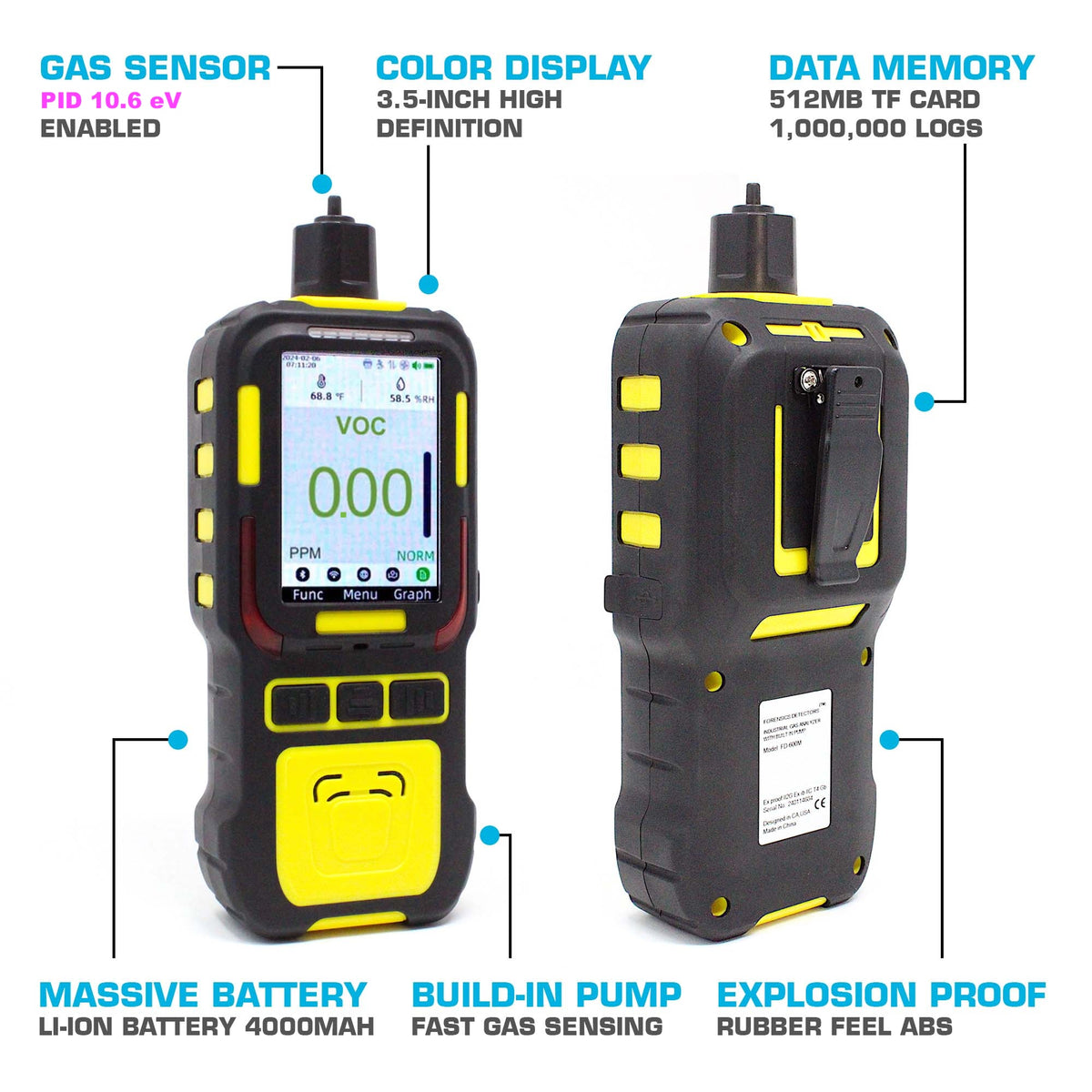
The primary difference between the FD-600M-PID-LOW and FD-600M-PID-HIGH is the concentration range and measurement resolution. The low-range model measures from 0 to 20 ppm with fine 0.01 ppm resolution, making it better suited to applications where small concentration changes and sub-ppm measurements are important. The high-range model extends measurement to 1000 ppm with 1 ppm resolution, making it more appropriate where substantially higher VOC concentrations may be encountered.
When Is the 0–20 ppm Low-Range PID the Better Choice?
The FD-600M-PID-LOW is the better choice when measurement sensitivity is more important than having a very large upper detection range. Its 0.01 ppm resolution allows an operator to observe concentration changes that would not be visible on an instrument displaying only whole ppm values, making the low-range configuration useful for low-level VOC investigations, industrial hygiene surveys, environmental screening, contamination tracing, sensitive leak investigations, and applications where the expected concentration is well below 20 ppm.
When Is the 0–1000 ppm High-Range PID the Better Choice?
The FD-600M-PID-HIGH is designed for environments where VOC concentrations may extend well beyond the low-ppm range, offering measurement from 0 to 1000 ppm with 1 ppm resolution. This makes it more appropriate for industrial process investigations, chemical spills, solvent-rich environments, fuel vapor monitoring, source tracing, and other applications where potentially high VOC concentrations may be encountered. The wider measurement range reduces the likelihood of exceeding the instrument's measurable range during a high-concentration event, although the 1 ppm resolution means it does not provide the same low-level detail as the 0.01 ppm low-range version.
Why Are PID Measurements Commonly Referenced to Isobutylene?
PID instruments are commonly calibrated using isobutylene because different VOCs produce different levels of response from the same PID sensor even when their actual concentrations are identical. Calibration to a known reference gas establishes a consistent baseline from which other VOC concentrations can be estimated.
Why Is a Built-In Sampling Pump Important in a PID Analyzer?
A built-in pump actively draws air through the PID rather than relying solely on passive diffusion, which gives the operator greater control over where the sample originates and makes the analyzer useful for point sampling, source investigations, probes, tubing, and difficult-to-reach locations.
Can a PID Identify the Exact VOC in the Air?
A PID can indicate that responsive organic vapors are present and provide a concentration-related signal, but it cannot independently identify an unknown chemical simply from its reading. Correction factors are most useful when the operator already knows or reasonably expects which compound is present; they do not turn a PID into a chemical identification instrument. Where positive identification of unknown compounds or complex mixtures is required, additional analytical techniques such as gas chromatography or laboratory analysis may be necessary.
What Can a 10.6 eV PID Not Detect?
A 10.6 eV PID cannot detect every gas or vapor because photoionization only occurs when the UV lamp provides enough energy to ionize the molecule being sampled. Compounds with ionization potentials higher than 10.6 eV may produce little or no response, and common atmospheric gases such as nitrogen, oxygen, carbon dioxide, and methane are not normally detected by this type of PID. A number of compounds fall outside the practical detection capability of common PID lamps, and some chlorinated hydrocarbons may also have ionization potentials that are too high.
How Often Should a PID VOC Monitor Be Calibrated?
Regular calibration is essential because a PID's response can change as the UV lamp, sensing chamber, filters, pump system, and other components age or become contaminated. Forensics Detectors recommends a calibration interval of 12 months for both FD-600M-PID-LOW and FD-600M-PID-HIGH, and each analyzer is supplied with a signed and dated calibration certificate.
How Long Does a PID Sensor and UV Lamp Last?
For both Forensics Detectors PID models, the specified sensor service life is five years or approximately 10,000 operating hours of lamp use, but actual performance also depends on operating conditions and maintenance.
What Makes a PID Suitable for Industrial and Hazardous Locations?
A professional PID used in industrial environments must combine VOC sensitivity with practical durability, sampling capability, alarms, and suitable hazardous-location protection.
Final Words
A photoionization detector PID VOC analyzers is the superior option when detecting VOCs in air. It is more expensive but is the most accurate and reliable. The Forensics Detectors FD-600M-PID-LOW and FD-600M-PID-HIGH use the same 10.6 eV Baseline piD-TECH sensing platform but are optimized for different concentration ranges: the low-range model provides 0.01 ppm resolution from 0 to 20 ppm for sensitive VOC measurements, while the high-range model extends to 1000 ppm for applications where much larger concentrations may occur.
About The Author
Dr. Kos Galatsis ("Dr.Koz") is the President of FORENSICS DETECTORS where the company operates from the scenic Palos Verdes Peninsula in Los Angeles, California. He is a subject matter expert on gas sensor technology, gas detectors, gas meters, and gas analyzers. He has been designing, building, manufacturing, and testing toxic gas detection systems for over 20 years.

Every day is a blessing for Dr. Koz. He loves to help customers solve their unique problems. Dr. Koz also loves spending time with his wife and his three children going to the beach, grilling burgers, and enjoying the outdoors.
Read more about Forensics Detectors here.
Email: drkoz@forensicsdetectors.com