
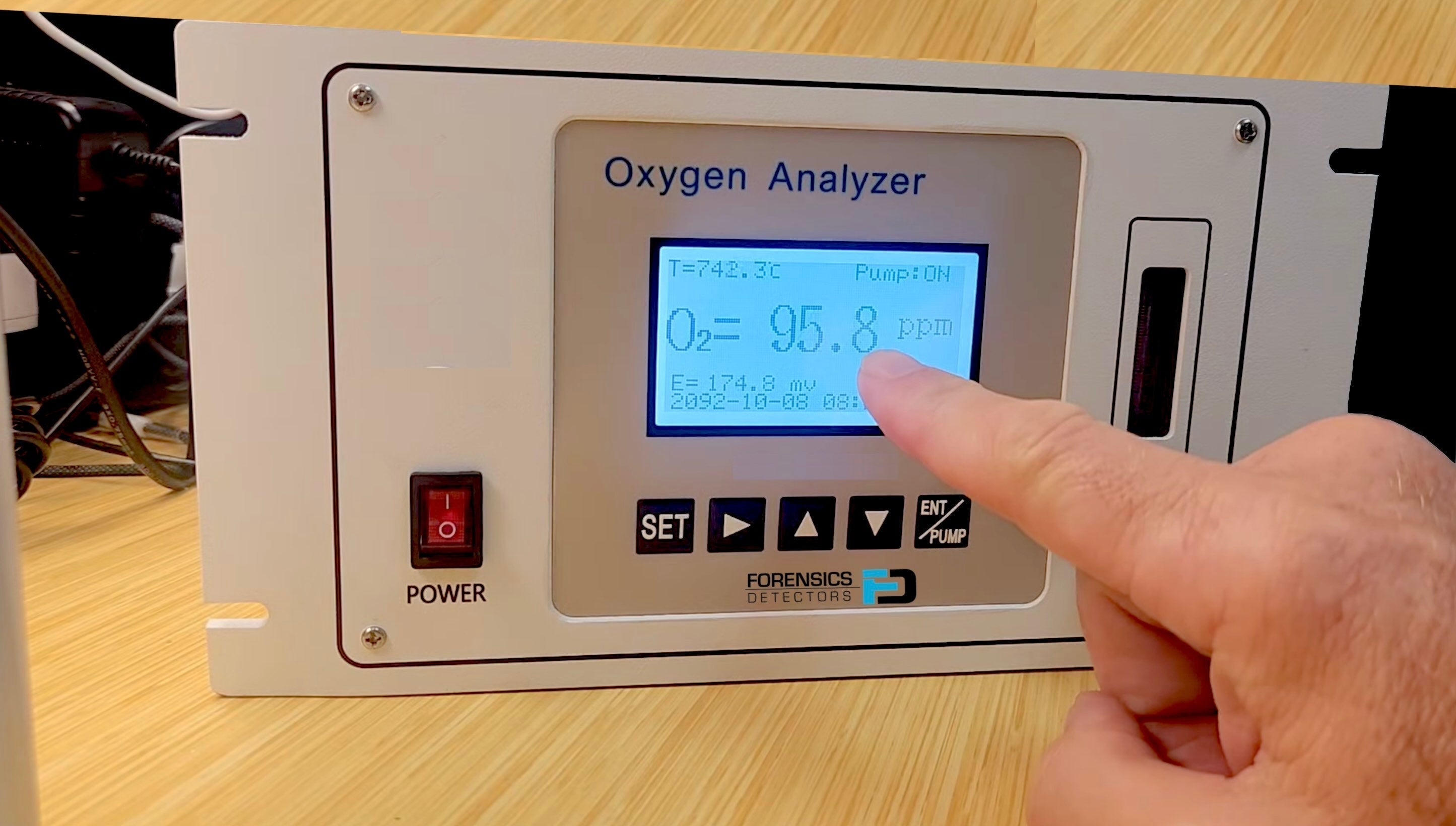
Zirconia oxygen analyzers are some of the most impressive oxygen gas analyzers to be made. They are stable, fast, and very accurate. This technology enables low-level, ppm-level detection of oxygen. Unlike the rugged zirconia lambda sensors used in automotive exhaust systems, benchtop types are scientific-grade instruments designed to measure pure gases, glovebox environments, semiconductor chambers, and specialized gas mixtures. Using solid-state physics, these analytical instruments deliver rapid results for detecting parts per billion (ppb) of oxygen gas.
Pros |
Cons |
|
✅ Detect down to trace levels 0.1 ppm ✅ Fast and accurate. ✅ Long life, more than electrochemical O2 sensors. ✅ Fast response < 10 seconds. |
⛔ They are hot. Operate at 750C. ⛔ Are bulky and heavy. ⛔ Much more expensive than the electrochemical type. |
What is the Best Zirconia Oxygen Analyzer (Benchtop)?
Forensics Detectors Zirconia Oxygen Analyzer
Process Insights Izrconia Oxygen Analyzer
Novatech Zirconia Oxygen Analyzers
Toray Zirconia Oxygen Analyzers
What is a Zirconia Oxygen Analyzer?
A benchtop zirconia oxygen analyzer is a gas analyzer used to determine the exact concentration of oxygen in a sample gas stream. Usually detecting down to 0.1 ppm. It is configured as a stationary piece of analytical equipment, featuring built-in sampling pumps, a zirconia sensor, flow meters, and precise temperature-controlled elements since the sensor operates at 750C.
How does an Oxygen Analyzer Zirconia System Work?
The principle of an oxygen analyzer zirconia system is the high-temperature concentration cell. At the heart of the benchtop instrument is a tube or disc made of zirconium dioxide with porous platinum electrodes attached to both ends.
When the zirconia ceramic is heated to temperatures between 600 and 750 °C, its crystal lattice opens up, allowing oxygen ions to travel through it like an electrolyte. This is why this material is called a solid electrolyte, unlike others that are mainly liquid.
One side of the cell is exposed to a known reference gas (20.9%), while the other side is exposed to the sample gas. The difference in oxygen partial pressure on either side of the heated barrier causes oxygen molecules to ionize, cross the ceramic, and discharge. This migration of ions generates an electrical voltage (electromotive force) across the platinum electrodes. This relationship is quantified by the Nernst Equation:
E = (RT / 4F) • ln(Pref / Psample)
Where E is the electromotive force, R is the gas constant, T is the absolute temperature, F is the Faraday constant, and P represents the partial pressures of oxygen. The instrument's internal electronics process this voltage signal to output a highly accurate, real-time oxygen concentration reading.
How Does Zirconia Compare to Other Oxygen Sensors?
| Metric | Zirconia Oxygen Analyzer | Electrochemical Sensors | Ultrasonic Oxygen Sensors |
| O2 Measurement Range | 0.01 ppm to 100% | ppm levels up to 25% | 20% to 100% |
| Lifespan | Long; 5–10+ years (Non-depleting) | Short; 1–3 years (Depleting chemical cell) | Moderate to Long (No moving parts) |
| Response Time | Ultra-fast (<1 second) | Slow to Moderate (15–30 seconds) | Fast (1–3 seconds) |
| Calibration Needs | Extremely low; holds factory baseline | Frequent; suffers from signal drift | Minimal; baseline stable |
| Combustible Gas Risk | High; gases burn on the heated sensor | None; works safely with hydrocarbons | None; safe in diverse mixtures |
| Sensitivity | Exceptional at low ppm/ppb levels | Poor at ultra-low levels over time | Poor; cannot resolve ppm levels |
Can a benchtop zirconia oxygen analyzer read both ppm and percent ranges?
Yes. One of the greatest assets of this oxygen analyzer configuration is its wide dynamic range. The logarithmic nature of the Nernst equation allows a single zirconia instrument to measure from 0.01 ppm up to 20.9 % oxygen without changing sensors or losing resolution.
Why is a reference gas required for a zirconia oxygen analyzer?
The system works on a differential pressure principle. To isolate the unknown partial pressure of your sample gas the instrument requires a known baseline pressure on the opposite side of the ceramic matrix. Clean, ambient air (20.9% O2) is standard.

Why must the zirconia element be heated to such high temperatures?
Zirconium dioxide is a non-conductive ceramic at room temperature. It only exhibits ion conductivity—the ability to let oxygen ions pass freely through its crystalline structures—when heated above 450C.
Is an oxygen analyzer zirconia system subject to sensor drift?
Virtually no. Because it is an absolute physical measurement rather than a depleting chemical reaction, the structural properties of the zirconia ceramic do not degrade during normal operation. This provides long-term calibration stability over years of continuous use.
What industrial environments utilize benchtop zirconia analyzers?
These benchtop instruments are widely deployed in semiconductor manufacturing (wafer processing), electronics reflow ovens, glovebox monitoring, gas purity validation, modified atmosphere packaging (MAP) for food, and pharmaceutical manufacturing.
How does a zirconia sensor differ from an automotive lambda sensor?
While both use zirconium dioxide, an automotive lambda sensor is a rugged tool designed to detect the transition point between rich and lean fuel mixtures in harsh exhausts. A benchtop analytical zirconia oxygen analyzer is a highly instrumented system with fine flow control and precise electronics designed for absolute quantitative evaluation of clean laboratory gases.
What happens if combustible gases enter the analyzer?
If combustible gases like hydrogen H2, carbon monoxide CO, or methane CH4 enter the instrument, they will instantly combust on the heated platinum electrode surface using the available oxygen in the sample. This consumes oxygen, leading to falsely low oxygen concentration readings.
Can background gases like Helium or Argon affect the measurement?
No. An oxygen analyzer zirconia element is exclusively responsive to oxygen ion migration. Inert background carrier gases like helium, argon, or nitrogen have no cross-sensitivity, making the analyzer an excellent choice for tracking trace impurities in pure noble gases.
Does a zirconia oxygen analyzer require frequent calibration?
No. Unlike electrochemical alternatives that require routine recalibrations as their gel electrolytes consume themselves, a zirconia analyzer holds its calibration baseline for long periods. Most laboratory protocols only call for a quick verification using ambient air or a certified gas standard once or twice a year.
What is the typical response time of this analyzer?
Because the ion exchange process across the thin ceramic barrier happens near-instantaneously at high temperatures, the sensor's response time is usually under one second. The overall system response time is primarily limited by the transport time of the sample gas through the intake tubing.
What are the primary contaminants that can ruin a zirconia sensor?
The most hazardous compounds are organic silicones, halogens (like chlorine), heavy metals, and corrosive gases such as high concentrations of SOx or NOx. Silicones coat the catalytic platinum electrodes, permanently "poisoning" the sensor and making ion transfer impossible.
Can a zirconia analyzer operate under variable sample pressures?
Yes, but the gas pressure must be regulated. Because the Nernst equation calculates the partial pressure of oxygen, changes in total sample pressure will directly alter the reading. Benchtop units use internal pressure regulators and flow control loops to keep the pressure constant.
Is a zirconia oxygen analyzer safe for explosive atmospheres?
Standard benchtop zirconia analyzers are not considered intrinsically safe for explosive zones because their internal furnaces run at temperatures well above the ignition points of many flammable gases. They should always be used to sample safe streams or placed in non-hazardous laboratory environments.
What is the typical lifespan of a zirconia cell?
In a clean analytical environment free of corrosive gases or silicones, a benchtop zirconia cell can easily operate continuously for 5 to 10 years (or over 35,000 operational hours) before requiring factory replacement.
Why are platinum electrodes used on the zirconia element?
Platinum serves a dual purpose. It acts as an electrical conductor to transmit the generated voltage, and it acts as a catalyst that facilitates the breakdown of molecular oxygen O2 into oxygen ions at the entry interface.
Is the initial investment in a zirconia oxygen analyzer justified?
Yes. While the initial purchase price is higher than that of simple electrochemical or ultrasonic monitors, its long service life, near-zero consumable costs, extreme precision, and low maintenance overhead offer a lower total cost of ownership over its operational life.
Conclusion
The benchtop zirconia oxygen analyzer remains a premier choice for high-precision laboratory, semiconductor, and process analysis tasks. By leveraging the predictable physics of Nernstian ion conduction through heated ceramics, it provides accurate data across an incredibly wide range of concentrations. While users must keep the sample stream free of flammable contaminants and thermal-shock risks, the advantages of fast response times, exceptional longevity, and minimal calibration drift make this technology a reliable choice for critical gas analysis infrastructure.