
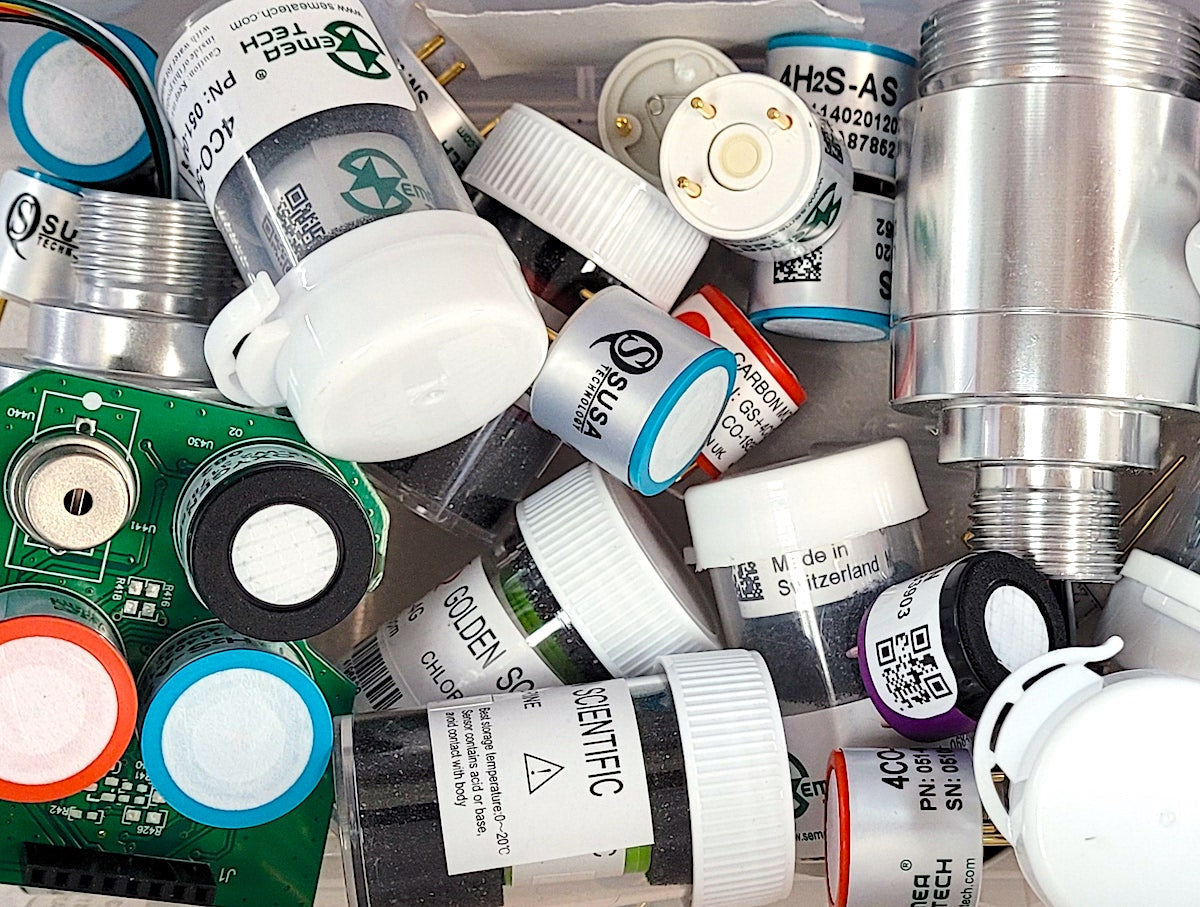
Einführung
Es gibt keinen perfekten Gassensor. Alle Gassensoren reagieren auch auf andere Gase. Die Frage ist, in welchem Ausmaß? Die Definition dieses Ausmaßes der Empfindlichkeit nennt man Kreuzempfindlichkeit.
Was ist Kreuzempfindlichkeit bei Gassensoren?
Obwohl ein Sensor hauptsächlich zur Erkennung eines bestimmten Gases entwickelt wurde, zeigt er auch eine Reaktion auf andere Gase. Diese Kreuzempfindlichkeit kann potenziell zu ungenauen Messungen oder Fehlalarmen führen, wenn sie nicht korrekt berücksichtigt wird.

Welche Faktoren bestimmen die Kreuzempfindlichkeit?
Die Grundlagen elektrochemischer Gassensoren und metalloxid-halbleitender Gassensoren beruhen auf der Oxidation oder Reduktion des Zielgases an der Elektrodenoberfläche, die einen Strom erzeugt, der proportional zur Gaskonzentration ist. Kreuzempfindlichkeit tritt auf, wenn andere Gase ebenfalls mit der Elektrodenoberfläche reagieren und einen Strom erzeugen, der das Zielgassignal stört. Das Ausmaß der Kreuzempfindlichkeit hängt von verschiedenen Faktoren ab, wie dem Elektrodenmaterial, der Gasdiffusionsrate, den Testdurchflussraten, dem Alter des Sensors, der Kalibrierungsexpositionszeit, der Einweichzeit, der Erholungszeit seit der vorherigen Exposition sowie der Betriebstemperatur und Luftfeuchtigkeit.
Wie kann ich Kreuzempfindlichkeiten minimieren?
Um Kreuzempfindlichkeiten zu minimieren, können verschiedene Strategien angewendet werden, wie z. B. die Verwendung von Gasfiltern, die Optimierung des Sensordesigns sowie die Anwendung von Kalibrierungs- und Kompensationstechniken.
Welche Arten von Kreuzempfindlichkeiten gibt es?
- Positive Reaktion: Der Sensor reagiert auf das Zielgas und ein weiteres Gas. Diese Reaktion vermittelt dem Benutzer den Eindruck, dass Zielgas vorhanden ist, obwohl dies nicht der Fall ist, oder dass mehr Zielgas vorhanden ist, als tatsächlich vorhanden ist. Das Ergebnis ist eine Überlagerung.
- Negative Reaktion: Der Sensor zeigt eine verringerte Reaktion auf das Zielgas und kann die positive Reaktion auf das Zielgas neutralisieren. Dies tritt häufig auf, wenn sowohl reduzierende als auch oxidierende Gase vorhanden sind, die das Sensorsignal gegenseitig aufheben können. Aus Sicherheitsgründen stellt eine negative Kreuzempfindlichkeit ein höheres Risiko dar als eine positive, da sie die Reaktion auf das Zielgas abschwächt und einen Alarm verhindern kann.
- Hemmung: Ein Gas oder eine Gaszusammensetzung hemmt die Erkennung des Zielgasanalyten, sodass keine positive Sensorsignalisierung erfolgt.
Kreuzempfindlichkeit und Ersatzgas
In einigen Fällen wird das Kreuzempfindlichkeitsverhalten eines Sensors für Kalibrierungszwecke genutzt. Dies geschieht nur, wenn das Zielgas in Form von Kalibriergas nicht verfügbar ist. Beispiele hierfür sind Wasserstoffperoxid und Chlordioxid-Gas. In diesen Fällen darf die Ersatzkalibrierung nur in einer kontrollierten Laborumgebung durchgeführt werden, da die Größenordnungen der Kreuzempfindlichkeit durch Temperatur, Expositionszeit, Einwirkzeit, Sensoralter, Luftfeuchtigkeit und Gasdurchflussraten variieren können.
Kreuzempfindlichkeitstabellen
Wir haben das zusammengestellt, was wir für die umfassendsten Kreuzempfindlichkeitstabellen halten. Diese Daten wurden über viele Jahre Erfahrung und Tests sowie durch eine gründliche Literaturauswertung zahlreicher vertrauenswürdiger Gassensorlieferanten gesammelt.
Behandeln Sie die Tabellen als Schätzwerte, da die Größenordnungen der Kreuzempfindlichkeit je nach Sensordesign und Testbedingungen um bis zu +/-100 % variieren können. Die angegebenen Werte basieren auf einer Testtemperatur von 20 °C und einer Luftfeuchtigkeit von 50 % rF.
Außerdem werden Gasgemische (Gasmatrix) selten getestet, und Ergebnisse mit Mischgasen sind unvorhersehbar. Die Tabelle ist alphabetisch geordnet.
Acrylnitril (C3H3N)
Sensortyp: Elektrochemischer Gassensor
|
Gas |
Konzentration (ppm) | Ausgangssignal (in ppm C3H3N) |
|---|---|---|
| Acetylen | 10 | 10 |
| Schwefelwasserstoff | 50 | < 1,0 |
| Schwefeldioxid | 10 | < 1,0 |
| Stickstoffmonoxid | 50 | < 1,0 |
| Formaldehyd | 10 | < 1,0 |
| Ammoniak | 50 | 0.0 |
| Kohlenmonoxid | 100 | < 1,0 |
| Ethylen | 100 | < 1,0 |
| Vinylchlorid | 100 | < 1,0 |
| Ethanol | 200 | < 1,0 |
Acetylen (C2H2)
Sensortyp: Elektrochemischer Gassensor
| Gas | Konzentration (ppm) | Ausgangssignal (in ppm C2H2) |
|---|---|---|
| Acetylen | 10 | 10 |
| Schwefelwasserstoff | 50 | < 1,0 |
| Schwefeldioxid | 10 | < 1,0 |
| Stickstoffmonoxid | 50 | < 1,0 |
| Formaldehyd | 10 | < 1,0 |
| Ammoniak | 50 | 0.0 |
| Kohlenmonoxid | 100 | < 1,0 |
| Ethylen | 100 | < 1,0 |
| Vinylchlorid | 100 | < 1,0 |
| Ethanol | 200 | < 1,0 |
AAlkohol
Sensortyp: Elektrochemischer Gassensor
| Gas | Konzentration (ppm) | Ausgangssignal (in ppm C4H8) |
|---|---|---|
| Methanol | 50 | 50 |
| Isobutylen* | 50 | 60 |
| Ethanol | 50 | 20 |
| Isopropanol | 50 | 30 |
Säure
Sensortyp: Elektrochemischer Gassensor
| Gas | Konzentration (ppm) |
Ausgangssignal (in ppm NO2) |
|---|---|---|
| Stickstoffdioxid* | 10 | 10 |
| Ameisensäure | 10 | 20 |
| Essigsäure | 10 | 2 |
| HCl | 10 | 1 |
Ammoniak (NH3)
Sensortyp: Elektrochemischer Gassensor
| Gas | Konzentration (ppm) | Ausgangssignal (in ppm NH3) |
|---|---|---|
| Ammoniak | 10 | 10 |
| Schwefelwasserstoff* | 25 | 50 |
| Kohlendioxid | 5,000 | 0.0 |
| Kohlenmonoxid | 100 | 0.0 |
| Wasserstoff | 1,000 | 0.0 |
| Isobutylen | 100 | 0.0 |
| Ethanol | 200 | < 1,0 |
Arsin (AsH3)
Sensortyp: Elektrochemischer Gassensor
| Gas | Konzentration (ppm) | Ausgangssignal (in ppm AsH3) |
|---|---|---|
| Arsin | 10 | 10 |
| Schwefeldioxid | 10 | 1.5 |
| Stickstoffmonoxid | 35 | -0.5 |
| Ammoniak | 30 | 0.0 |
| Wasserstoff | 1000 | 0.7 |
| Stickstoffdioxid | 10 | -2.0 |
| Schwefelwasserstoff | 2 | 1.8 |
| Kohlendioxid | 5000 | 0.0 |
| Chlor | 10 | -1.3 |
| Ethylen | 50 | 0.0 |
| Kohlenmonoxid | 100 | 0.9 |
Benzol (C6H6)
Sensortyp: Photoionisationsdetektor (PID-Sensor)
| Gas | Konzentration (ppm) |
Ausgangssignal (in ppm C6H6) |
|---|---|---|
| Benzol | 10 | 10 |
| Aceton | 10 | 12 |
| Isobutylen* | 10 | 7 |
| Xylol | 10 | 5 |
| Toluol | 10 | 6 |
Brom (Br2)
Sensortyp: Elektrochemischer Gassensor
| Gas | Konzentration (ppm) | Ausgangssignal (in ppm Br2) |
|---|---|---|
| Brom | 10 | 10 |
| Ethylen | 100 | 0 |
| Formaldehyd | 7 | 0 |
| Kohlenmonoxid | 300 | 0 |
| Ethanol | 60 | 0 |
| Wasserstoff | 100 | 0 |
| Schwefelwasserstoff | 20 | < -10 |
| Chlorwasserstoff | 20 | 0 |
| Stickstoffdioxid | 10 | 12 |
| Ozon* | 1 | 2 |
Kohlenstoffdisulfid (CS₂)
Sensortyp: Elektrochemischer Gassensor
| Gas | Konzentration (ppm) | Ausgangssignal (in ppm CS₂) |
|---|---|---|
| Kohlenstoffdisulfid | 100 | 100 |
| Ethylen | 100 | < 2 |
| Kohlenmonoxid* | 200 | 100 |
| Wasserstoff | 100 | 0 |
| Schwefelwasserstoff | 20 | 0 |
| Stickstoffmonoxid | 100 | 0 |
| Stickstoffdioxid | 20 | 0 |
| Phosphin | 20 | 0 |
| Schwefeldioxid | 100 | 0 |
Kohlenmonoxid (CO)
Sensortyp: Elektrochemischer Gassensor
| Gas | Konzentration (ppm) | Ausgangssignal (in ppm CO) |
|---|---|---|
| Kohlenmonoxid | 10 | 10 |
| Schwefelwasserstoff | 15 | -0.1 |
| Schwefeldioxid | 10 | -0.2 |
| Stickstoffmonoxid | 50 | -16.0 |
| Stickstoffdioxid | 10 | -2.6 |
| Ammoniak | 50 | 0.0 |
| Wasserstoff | 100 | 24.0 |
| Ethylen | 100 | 10.0 |
| Chlor | 15 | -0.5 |
| Ethanol | 200 | 1.5 |
Chlor (Cl2)
Sensortyp: Elektrochemischer Gassensor
| Gas | Konzentration (ppm) | Ausgangssignal (in ppm Cl2) |
|---|---|---|
| Chlor | 10 | 10 |
| Schwefelwasserstoff | 10 | -12.0 |
| Schwefeldioxid | 20 | 0.0 |
| Stickstoffmonoxid | 10 | 0.1 |
| Stickstoffdioxid | 10 | 20 |
| Ozon* | 10 | 20 |
| Kohlenmonoxid | 100 | 0.0 |
| Ammoniak | 100 | 0.1 |
| Wasserstoff | 1,000 | -0.1 |
| Kohlendioxid | 30,000 | 0.0 |
Chlordioxid (ClO₂)
Sensortyp: Elektrochemischer Gassensor
| Gas | Konzentration (ppm) | Ausgangssignal (in ppm ClO2) |
|---|---|---|
| Chlordioxid | 10 | 10 |
| Schwefelwasserstoff | 20 | -5.0 |
| Stickstoffdioxid | 10 | 16.0 |
| Kohlenmonoxid | 100 | 0.0 |
| Wasserstoff | 3,000 | 0.0 |
| Chlor* | 10 | 13 |
| Kohlendioxid | 5,000 | 0.0 |
| Ozon* | 10 | 30 |
Cyclohexanol (C6H12O)
Sensortyp: Elektrochemischer Gassensor
| Gas | Konzentration (ppm) | Ausgangssignal (in ppm C6H12O) |
|---|---|---|
| Cyclohexanol | 10 | 10 |
| Kohlendioxid | 3000 | 0 |
| Kohlenmonoxid | 25 | 100 |
| Methan | 1000 | 0 |
Diboran (B2H6)
Sensortyp: Elektrochemischer Gassensor
| Gas | Konzentration (ppm) | Ausgangssignal (in ppm B2H6) |
|---|---|---|
| Diboran | 10 | 10 |
| Schwefelwasserstoff * | 5 | 2.5 |
| Schwefeldioxid | 20 | 3.7 |
| Phosphin | 5 | 5 |
| Ammoniak | 100 | 0 |
| Kohlenmonoxid | 100 | 0 |
| Kohlendioxid | 5000 | 0 |
Ethylen (C2H4)
Sensortyp: Elektrochemischer Gassensor
| Gas | Konzentration (ppm) | Ausgangssignal (in ppm C2H4) |
|---|---|---|
| Ethylen | 10 | 10 |
| Schwefelwasserstoff | 50 | < 1,0 |
| Schwefeldioxid | 100 | < 1,0 |
| Stickstoffmonoxid* | 100 | 60.0 |
| Formaldehyd | 10 | < 1,0 |
| Ammoniak | 50 | 0.0 |
| Kohlenmonoxid | 100 | < 1,0 |
| Acetylen* | 10 | 15.0 |
| Vinylchlorid | 100 | < 1,0 |
| Ethanol | 500 | < 1,0 |
Ethylenglykol (C2H4O)
Sensortyp: Elektrochemischer Gassensor
| Gas | Konzentration (ppm) | Ausgangssignal (in ppm ETO) |
|---|---|---|
| Ethylenglykol | 50 | 50 |
| Kohlenmonoxid | 25 | 10.0 |
| Isobutylen* | 50 | 45.0 |
| Ethylen | 50 | 35.0 |
| Acetylen | 50 | 35.0 |
| Ethanol | 100 | 45.0 |
| Methanol | 30 | 25.0 |
| Ameisensäure | 100 | 30.0 |
Formaldehyd (CH2O)
Sensortyp: Elektrochemischer Gassensor
| Gas | Konzentration (ppm) | Ausgangssignal (in ppm CH2O) |
|---|---|---|
| Formaldehyd | 10 | 10 |
| Kohlenmonoxid | 50 | 1.6 |
| Schwefeldioxid* | 10 | 8 |
| Essigsäure | 2,000 | -0.3 |
| Ethylen | 100 | 0.3 |
| Methanol | 100 | 0.1 |
| Isopropanol | 100 | 0.1 |
Fluor (F2)
Sensortyp: Elektrochemischer Gassensor
| Gas | Konzentration (ppm) | Ausgangssignal (in ppm F2) |
|---|---|---|
| Fluor | 10 | 10 |
| Alkohole | 1000 | 0 |
| Arsin | 0.2 | -0,03 |
| Kohlendioxid | 5000 | 0 |
| Kohlenmonoxid | 100 | 0 |
| Chlor | 1 | 1.4 |
| Diboran | 0.25 | -0.01 |
| Kohlenwasserstoffe | % Bereich | 0 |
| Salzsäure | 5 | -7 |
| Wasserstoff | 10000 | 0 |
| Blausäure | 1 | -0.05 |
| Schwefelwasserstoff | 1 | -2 |
| Stickstoff | 100% | 0 |
| Stickstoffdioxid | 10 | 8 |
| Ozon | 0.25 | 0.3 |
| Phosphin | 0.3 | ca. -0,1 ppm; n/v |
| Schwefeldioxid | 20 | -0.2 |
Hydrazin (N2H4)
Sensortyp: Elektrochemischer Gassensor
| Gas | Konzentration (ppm) | Ausgangssignal (in ppm N2H4) |
|---|---|---|
| Hydrazin | 10 | 10 |
| Ammoniak | 1.2 | 1 |
| Kohlendioxid | 1000 | 0 |
| Kohlenmonoxid | 1 | 1.8 |
| Methan | 1000 | 0 |
| Methylhydrazin | 1 | 0.8 |
Wasserstoff (H2)
Sensortyp: Elektrochemischer Gassensor
| Gas | Konzentration (ppm) | Ausgangssignal (in ppm H2) |
|---|---|---|
| Wasserstoff | 100 | 100 |
| Schwefelwasserstoff | 25 | 0.0 |
| Schwefeldioxid | 5 | 0.0 |
| Kohlenmonoxid | 50 | 200.0 |
| Stickstoffmonoxid | 35 | < 10,0 |
| Stickstoffdioxid | 5 | 0.0 |
| Ethylen | 100 | 80.0 |
| Chlor | 10 | 0.0 |
Bromwasserstoff (HBr)
Sensortyp: Elektrochemischer Gassensor
| Gas | Konzentration (ppm) | Ausgangssignal (in ppm HBr) |
|---|---|---|
| Bromwasserstoff | 10 | 10 |
| Chlor | 20 | -8 |
| Kohlenmonoxid | 100 | 1 |
| Wasserstoff | 1,000 | <1 |
| Stickstoffdioxid* | 10 | 2 |
| Schwefeldioxid | 20 | 52 |
| Ethylen | 100 | 1 |
| Schwefelwasserstoff | 5 | 60 |
Salzsäure (HCl)
Sensortyp: Elektrochemischer Gassensor
| Gas | Konzentration (ppm) | Ausgangssignal (in ppm HCl) |
|---|---|---|
| Chlorwasserstoff | 10 | 10 |
| Kohlenmonoxid | 100 | 0.0 |
| Schwefeldioxid* | 10 | 25.0 |
| Stickstoffmonoxid | 20 | 50.0 |
| Stickstoffdioxid | 10 | 1.0 |
| Wasserstoff | 2,000 | 0.0 |
| Schwefelwasserstoff | 25 | 100.0 |
| Stickstoff | 100% | 0.0 |
| Chlor | 20 | -5.0 |
Blausäure (HCN)
Sensortyp: Elektrochemischer Gassensor
| Gas | Konzentration (ppm) | Ausgangssignal (in ppm HCN) |
|---|---|---|
| Blausäure | 10 | 10 |
| Kohlenmonoxid | 300 | 0.0 |
| Schwefeldioxid* | 5 | 18.1 |
| Stickstoffmonoxid | 35 | 0.0 |
| Stickstoffdioxid | 5 | -9.5 |
| Schwefelwasserstoff | 5 | 14.9 |
| Ethylen | 100 | 0.0 |
| Kohlendioxid | 5000 | 0.0 |
| Ethanol | 600 | 0.0 |
Flusssäure (HF)
Sensortyp: Elektrochemischer Gassensor
| Gas | Konzentration (ppm) | Ausgangssignal (in ppm HF) |
|---|---|---|
| Flusssäure | 10 | 10 |
| Schwefelwasserstoff | 25 | -1.0 |
| Schwefeldioxid | 20 | -0.2 |
| Stickstoffmonoxid | 50 | 0.0 |
| Stickstoffdioxid* | 5 | 5 |
| Kohlenmonoxid | 100 | 0.0 |
| Wasserstoff | 1,000 | 0.0 |
Wasserstoffperoxid (H2O2)
Sensortyp: Elektrochemischer Gassensor
Gas
Konzentration (ppm)
Ausgangssignal
(in ppm H2O2)
Wasserstoffperoxid
10
10
Schwefeldioxid
20
20
Schwefelwasserstoff (H₂S)
Sensortyp: Elektrochemischer Gassensor
Gas
Konzentration (ppm)
Ausgangssignal
(in ppm H2S)
Schwefelwasserstoff
10
10
Kohlenmonoxid
100
0.0
Stickstoffmonoxid
50
-0.7
Stickstoffdioxid
10
-2.1
Ammoniak
50
3.8
Wasserstoff
1,000
0.0
Chlor
15
-7.8
Schwefeldioxid
20
16.1
Ethylen
100
0.0
Ethanol
2,000
0.0
Mercaptan (CH4S)
Sensortyp: Elektrochemischer Gassensor
Gas
Konzentration (ppm)
Ausgangssignal
(in ppm CH4S)
Methanthiol
10
10
Kohlenmonoxid
50
< 5,5
Schwefeldioxid
5
< 2,1
Stickstoffdioxid
5
< -3,5
Stickstoffmonoxid
25
0.0
Ammoniak
50
0.0
Wasserstoff
1,000
< 10,0
Schwefelwasserstoff
25
40.0
Stickstoffmonoxid (NO)
Sensortyp: Elektrochemischer Gassensor
Gas
Konzentration (ppm)
Ausgangssignal
(in ppm NO)
Stickstoffmonoxid
10
10
Schwefelwasserstoff*
25
11.0
Kohlenmonoxid
100
0.0
Stickstoffdioxid
5
< 0,2
Schwefeldioxid
5
< 0,3
Ethylen
100
0.0
Wasserstoff
1,000
< 0,3
Stickstoffdioxid (NO₂)
Sensortyp: Elektrochemischer Gassensor
Gas
Konzentration (ppm)
Ausgangssignal
(in ppm NO2)
Stickstoffdioxid
10
10
Schwefelwasserstoff
15
< -5,0
Kohlenmonoxid
300
0.0
Stickstoffmonoxid
35
0.0
Chlor
10
1
Schwefeldioxid
5
-5.0
Ozon*
10
5
Ozon (O₃)
Sensortyp: Elektrochemischer Gassensor
Gas
Konzentration (ppm)
Ausgangssignal
(in ppm O3)
Ozon
10
10
Schwefelwasserstoff
20
-4.0
Schwefeldioxid
20
< 1,0
Stickstoffmonoxid
50
< 1,0
Stickstoffdioxid
10
10
Kohlenmonoxid
100
0.0
Ammoniak
100
0.0
Wasserstoff
1,000
0.0
Chlor
10
9.0
Kohlendioxid
10,000
0.0
Sauerstoff (O₂)
Sensortyp: Elektrochemischer Gassensor
Gas
Konzentration
Ausgangssignal
(in %O2-Äquivalent)
Sauerstoff
10%
10%
Kohlendioxid
5%
0.1%
Wasserstoff
0.2%
-0.2%
Phosgen (COCl2)
Sensortyp: Elektrochemischer Gassensor
Gas
Konzentration (ppm)
Ausgangssignal
(in ppm COCl2)
Phosgen
10
10
Chlor
5
26.4
Kohlendioxid
3,000
0.0
Kohlenmonoxid
50
0.0
Wasserstoff
1,000
0.0
Schwefelwasserstoff
5
-3.3
Ammoniak
10
-2.5
Stickstoffmonoxid
10
0.0
Phosphin (PH₃)
Sensortyp: Elektrochemischer Gassensor
Gas
Konzentration (ppm)
Ausgangssignal
(in ppm PH3)
Phosphin
10
10
Schwefelwasserstoff*
15
12.0
Schwefeldioxid
20
6.2
Ammoniak
50
0.0
Wasserstoff
1,000
0.0
Kohlenmonoxid
1,000
0.0
Ethylen
100
0.0
Silan (SiH4)
Sensortyp: Elektrochemischer Gassensor
Gas
Konzentration (ppm)
Ausgangssignal
(in ppm SiH4)
Silan
10
10
Schwefeldioxid
20
6.6
Stickstoffmonoxid
50
0.0
Ammoniak
50
0.0
Kohlenmonoxid
100
4.1
Stickstoffdioxid
10
-3.1
Schwefelwasserstoff
2
1.7
Chlor
15
-3.9
Schwefeldioxid (SO2)
Sensortyp: Elektrochemischer Gassensor
Gas
Konzentration (ppm)
Ausgangssignal
(in ppm SO2)
Schwefeldioxid
10
10
Schwefelwasserstoff
15
0.1
Kohlenmonoxid
100
0.0
Stickstoffmonoxid
50
0.1
Stickstoffdioxid
5
-5.5
Wasserstoff
1,000
0.2
Ammoniak
20
0.0
Chlor
5
-1.5
Acetylen
10
< 2,0
Ethylen
50
0.2
Styrol
Sensortyp: Elektrochemischer Gassensor
Gas
Konzentration (ppm)
Ausgangssignal
(in ppm VOC)
Styrol
10
10
Isobutylen *
10
10
Ethylen
5
3.16
Formaldehyd
5
6
Methylmercaptan
5
7
Ethylenglykol
5
3.83
Ethanol
5
1.83
Kohlenstoffdisulfid
5
1.23
Dimethyldisulfid
2
6.8
Methanol
5
5.95
Methylsulfid
5
8.97
Styrol
0.5
7.5
Benzol
5
1.1
Toluol
5
0.81
O-Xylol
5
0.58
Kraftstoffverdunstung
(dimensionslos)
/
Gut reagiert
Acrylnitril
/
Gut reagiert
Acetylen
/
Gut reagiert
Ameisensäure
5
5.36
Essigsäure
5
1.1
Kohlenmonoxid
5
3.38
Chlorwasserstoff
5
0.27
Blausäure
5
0.36
Ammoniak
5
1.5
Wasserstoff
5
1.15
Trimethylamin
5
0.65
Stickstoffdioxid
5
1.86
Tetrahydrothiofen (C4H8S) THT
Sensortyp: Elektrochemischer Gassensor
Gas
Konzentration ( mg/m3)
Ausgangssignal
(in mg/m3 C4H8S)
Tetrahydrothiofen
10
10
Schwefelwasserstoff
25
8.5
Kohlenmonoxid
50
0.1
Stickstoffmonoxid
35
< 130,0
Schwefeldioxid
5
0.0
Stickstoffdioxid *
10
16.0
Vinylchlorid (C2H3Cl)
Sensortyp: Elektrochemischer Gassensor
Gas
Konzentration (ppm)
Ausgangssignal
(in ppm C2H3Cl)
Vinylchlorid
10
10
Kohlenmonoxid
25
15.0
Isobutylen
50
35.0
Ethylen
50
65.0
Acetylen
50
85.0
Ethanol
100
55.0
Flüchtige organische Verbindung (VOC)
Sensortyp: Elektrochemischer Gassensor
Gas
Konzentration (ppm)
Ausgangssignal
(in ppm VOC)
Flüchtige organische Verbindung
10
10
Isobuten
5
5
Ethylen
5
3.16
Formaldehyd
5
6
Methylmercaptan
5
7
Ethylenglykol
5
3.83
Ethanol
5
1.83
Kohlenstoffdisulfid
5
1.23
Dimethyldisulfid
2
6.8
Methanol
5
5.95
Methylsulfid
5
8.97
Styrol
0.5
7.5
Benzol
5
1.1
Toluol
5
0.81
O-Xylol
5
0.58
Kraftstoffverdunstung
(dimensionslos)
/
Gut reagiert
Acrylnitril
/
Gut reagiert
Acetylen
/
Gut reagiert
Ameisensäure
5
5.36
Essigsäure
5
1.1
Kohlenmonoxid
5
3.38
Chlorwasserstoff
5
0.27
Blausäure
5
0.36
Ammoniak
5
1.5
Wasserstoff
5
1.15
Trimethylamin
5
0.65
Stickstoffdioxid
5
1.86
(in ppm H2O2)
(in ppm H2S)
Mercaptan (CH4S)
Sensortyp: Elektrochemischer Gassensor
| Gas | Konzentration (ppm) | Ausgangssignal (in ppm CH4S) |
|---|---|---|
| Methanthiol | 10 | 10 |
| Kohlenmonoxid | 50 | < 5,5 |
| Schwefeldioxid | 5 | < 2,1 |
| Stickstoffdioxid | 5 | < -3,5 |
| Stickstoffmonoxid | 25 | 0.0 |
| Ammoniak | 50 | 0.0 |
| Wasserstoff | 1,000 | < 10,0 |
| Schwefelwasserstoff | 25 | 40.0 |
Stickstoffmonoxid (NO)
Sensortyp: Elektrochemischer Gassensor
| Gas | Konzentration (ppm) | Ausgangssignal (in ppm NO) |
|---|---|---|
| Stickstoffmonoxid | 10 | 10 |
| Schwefelwasserstoff* | 25 | 11.0 |
| Kohlenmonoxid | 100 | 0.0 |
| Stickstoffdioxid | 5 | < 0,2 |
| Schwefeldioxid | 5 | < 0,3 |
| Ethylen | 100 | 0.0 |
| Wasserstoff | 1,000 | < 0,3 |
Stickstoffdioxid (NO₂)
Sensortyp: Elektrochemischer Gassensor
| Gas | Konzentration (ppm) | Ausgangssignal (in ppm NO2) |
|---|---|---|
| Stickstoffdioxid | 10 | 10 |
| Schwefelwasserstoff | 15 | < -5,0 |
| Kohlenmonoxid | 300 | 0.0 |
| Stickstoffmonoxid | 35 | 0.0 |
| Chlor | 10 | 1 |
| Schwefeldioxid | 5 | -5.0 |
| Ozon* | 10 | 5 |
Ozon (O₃)
Sensortyp: Elektrochemischer Gassensor
| Gas | Konzentration (ppm) | Ausgangssignal (in ppm O3) |
|---|---|---|
| Ozon | 10 | 10 |
| Schwefelwasserstoff | 20 | -4.0 |
| Schwefeldioxid | 20 | < 1,0 |
| Stickstoffmonoxid | 50 | < 1,0 |
| Stickstoffdioxid | 10 | 10 |
| Kohlenmonoxid | 100 | 0.0 |
| Ammoniak | 100 | 0.0 |
| Wasserstoff | 1,000 | 0.0 |
| Chlor | 10 | 9.0 |
| Kohlendioxid | 10,000 | 0.0 |
Sauerstoff (O₂)
Sensortyp: Elektrochemischer Gassensor
| Gas | Konzentration | Ausgangssignal (in %O2-Äquivalent) |
|---|---|---|
| Sauerstoff | 10% | 10% |
| Kohlendioxid | 5% | 0.1% |
| Wasserstoff | 0.2% | -0.2% |
Phosgen (COCl2)
Sensortyp: Elektrochemischer Gassensor
| Gas | Konzentration (ppm) | Ausgangssignal (in ppm COCl2) |
|---|---|---|
| Phosgen | 10 | 10 |
| Chlor | 5 | 26.4 |
| Kohlendioxid | 3,000 | 0.0 |
| Kohlenmonoxid | 50 | 0.0 |
| Wasserstoff | 1,000 | 0.0 |
| Schwefelwasserstoff | 5 | -3.3 |
| Ammoniak | 10 | -2.5 |
| Stickstoffmonoxid | 10 | 0.0 |
Phosphin (PH₃)
Sensortyp: Elektrochemischer Gassensor
| Gas | Konzentration (ppm) | Ausgangssignal (in ppm PH3) |
|---|---|---|
| Phosphin | 10 | 10 |
| Schwefelwasserstoff* | 15 | 12.0 |
| Schwefeldioxid | 20 | 6.2 |
| Ammoniak | 50 | 0.0 |
| Wasserstoff | 1,000 | 0.0 |
| Kohlenmonoxid | 1,000 | 0.0 |
| Ethylen | 100 | 0.0 |
Silan (SiH4)
Sensortyp: Elektrochemischer Gassensor
| Gas | Konzentration (ppm) | Ausgangssignal (in ppm SiH4) |
|---|---|---|
| Silan | 10 | 10 |
| Schwefeldioxid | 20 | 6.6 |
| Stickstoffmonoxid | 50 | 0.0 |
| Ammoniak | 50 | 0.0 |
| Kohlenmonoxid | 100 | 4.1 |
| Stickstoffdioxid | 10 | -3.1 |
| Schwefelwasserstoff | 2 | 1.7 |
| Chlor | 15 | -3.9 |
Schwefeldioxid (SO2)
Sensortyp: Elektrochemischer Gassensor
| Gas | Konzentration (ppm) | Ausgangssignal (in ppm SO2) |
|---|---|---|
| Schwefeldioxid | 10 | 10 |
| Schwefelwasserstoff | 15 | 0.1 |
| Kohlenmonoxid | 100 | 0.0 |
| Stickstoffmonoxid | 50 | 0.1 |
| Stickstoffdioxid | 5 | -5.5 |
| Wasserstoff | 1,000 | 0.2 |
| Ammoniak | 20 | 0.0 |
| Chlor | 5 | -1.5 |
| Acetylen | 10 | < 2,0 |
| Ethylen | 50 | 0.2 |
Styrol
Sensortyp: Elektrochemischer Gassensor
| Gas | Konzentration (ppm) | Ausgangssignal (in ppm VOC) |
|---|---|---|
| Styrol | 10 | 10 |
| Isobutylen * | 10 | 10 |
| Ethylen | 5 | 3.16 |
| Formaldehyd | 5 | 6 |
| Methylmercaptan | 5 | 7 |
| Ethylenglykol | 5 | 3.83 |
| Ethanol | 5 | 1.83 |
| Kohlenstoffdisulfid | 5 | 1.23 |
| Dimethyldisulfid | 2 | 6.8 |
| Methanol | 5 | 5.95 |
| Methylsulfid | 5 | 8.97 |
| Styrol | 0.5 | 7.5 |
| Benzol | 5 | 1.1 |
| Toluol | 5 | 0.81 |
| O-Xylol | 5 | 0.58 |
| Kraftstoffverdunstung (dimensionslos) |
/ | Gut reagiert |
| Acrylnitril | / | Gut reagiert |
| Acetylen | / | Gut reagiert |
| Ameisensäure | 5 | 5.36 |
| Essigsäure | 5 | 1.1 |
| Kohlenmonoxid | 5 | 3.38 |
| Chlorwasserstoff | 5 | 0.27 |
| Blausäure | 5 | 0.36 |
| Ammoniak | 5 | 1.5 |
| Wasserstoff | 5 | 1.15 |
| Trimethylamin | 5 | 0.65 |
| Stickstoffdioxid | 5 | 1.86 |
Tetrahydrothiofen (C4H8S) THT
Sensortyp: Elektrochemischer Gassensor
| Gas | Konzentration ( mg/m3) | Ausgangssignal (in mg/m3 C4H8S) |
|---|---|---|
| Tetrahydrothiofen | 10 | 10 |
| Schwefelwasserstoff | 25 | 8.5 |
| Kohlenmonoxid | 50 | 0.1 |
| Stickstoffmonoxid | 35 | < 130,0 |
| Schwefeldioxid | 5 | 0.0 |
| Stickstoffdioxid * | 10 | 16.0 |
Vinylchlorid (C2H3Cl)
Sensortyp: Elektrochemischer Gassensor
| Gas | Konzentration (ppm) | Ausgangssignal (in ppm C2H3Cl) |
|---|---|---|
| Vinylchlorid | 10 | 10 |
| Kohlenmonoxid | 25 | 15.0 |
| Isobutylen | 50 | 35.0 |
| Ethylen | 50 | 65.0 |
| Acetylen | 50 | 85.0 |
| Ethanol | 100 | 55.0 |
Flüchtige organische Verbindung (VOC)
Sensortyp: Elektrochemischer Gassensor
| Gas | Konzentration (ppm) | Ausgangssignal (in ppm VOC) |
|---|---|---|
| Flüchtige organische Verbindung | 10 | 10 |
| Isobuten | 5 | 5 |
| Ethylen | 5 | 3.16 |
| Formaldehyd | 5 | 6 |
| Methylmercaptan | 5 | 7 |
| Ethylenglykol | 5 | 3.83 |
| Ethanol | 5 | 1.83 |
| Kohlenstoffdisulfid | 5 | 1.23 |
| Dimethyldisulfid | 2 | 6.8 |
| Methanol | 5 | 5.95 |
| Methylsulfid | 5 | 8.97 |
| Styrol | 0.5 | 7.5 |
| Benzol | 5 | 1.1 |
| Toluol | 5 | 0.81 |
| O-Xylol | 5 | 0.58 |
| Kraftstoffverdunstung (dimensionslos) |
/ | Gut reagiert |
| Acrylnitril | / | Gut reagiert |
| Acetylen | / | Gut reagiert |
| Ameisensäure | 5 | 5.36 |
| Essigsäure | 5 | 1.1 |
| Kohlenmonoxid | 5 | 3.38 |
| Chlorwasserstoff | 5 | 0.27 |
| Blausäure | 5 | 0.36 |
| Ammoniak | 5 | 1.5 |
| Wasserstoff | 5 | 1.15 |
| Trimethylamin | 5 | 0.65 |
| Stickstoffdioxid | 5 | 1.86 |